



By Nick Capra, Running Free Accessories buyer
The recent press surrounding the harmful leaching of toxins from plastic water bottles has had consumers scrambling for safe alternatives – and justifiably so. Bisphenol-A or BPA is the chemical at the heart of all the controversy. BPA is officially classified by the Government of Canada as a hormone disruptor. Several studies have shown that even miniscule amounts of BPA can lead to the development of serious health issues including breast and prostate cancer as well as miscarriage or birth defects. Although we know BPA can be quite harmful, the controversy is how much is or how much is not an acceptable amount that can be ingested. Plastic manufacturers and even some governments insist that low levels of ingested BPA do not pose any health risks while environmental and citizens groups say that even low levels are not acceptable. The Government of Canada is currently studying the issue once again and is to report on it some time in May of 2008. For now, BPA is still found in all kinds of consumer products including water bottles, baby bottles and even in the lining of canned foods. The bottom line as a consumer is; we have two conflicting sides that do not agree on the science and so at this point it’s up to us to decide if we would like to continue to be guinea pigs or just play it safe and wait until our government comes out with conclusive results. A wise person once told me “where there’s smoke there’s fire” and this issue has turned into an inferno. While most of us have only recently learned of the possible risks associated with BPA, questions around its safety date back to a study in 1998 – 10 years ago. Polycarbonates containing BPA are identified as recycling symbol #7 which falls into the “other” category of plastics. This category is broad and may comprise of a mixture of plastics.
I originally began my research into what is and what isn’t safe because of all the conflicting information and confusion by me and our customers at the shop when deciding on the purchase of a water bottle. As I dove into the plethora of conflicting data I have only one recommendation that I can say with all my confidence – the safest water bottles and food containers are stainless steel or glass. As far as the rest of the plastics go there are some questionable (some sources say good and some say bad) some out and out bad and some not known (at the moment) to leach any chemicals. Here is my unofficial list. Each of the following numbers represents it’s recycling code.
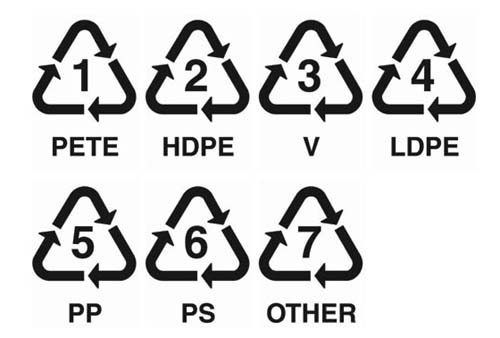
- PET or PETE – Questionable – depending on the quality, repeated use may cause the leaching of DEHA, a know human carcinogen. Light gauge containers such as store bought pop bottles should be a one time use only. Heavier gauge containers show no evidence of leaching chemicals.
- HDPE – OK – not known to leach unwanted chemicals.
- PVC or V – Bad – Strong evidence to show the leaching of DEHA, a known human carcinogen.
- LDPE – OK – not known to leach unwanted chemicals although not as widely recycled as #1 or #2.
- PP – OK – not known to leach unwanted chemicals although not as widely recycled
 as #1 or #2.
 - PS – Bad – suspected to possibly leach harmful carcinogens
- Assorted but usually polycarbonate – Bad – may contain leaching BPA.
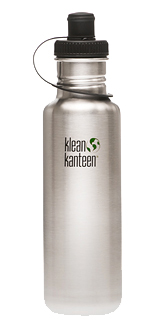
As the buyer of this sort of product at Running Free I felt compelled to educate myself as best I could and get to the bottom of all this confusion. Ultimately I want what is best for our customers, and so I embarked on this quest for clarity. Last year we introduced Klean Kanteen stainless steel water bottles in 18, 27 and 40 oz sizes. Klean Kanteen is the result of an intense search to source out the safest option. I would have loved to have listed all the sources I gathered the information from to come to the conclusions that I ultimately came to, but the list would be 10 pages long. My sources included government, university, manufactures, media reports as well as environmental and science watchdogs and various NGO’s. I read and read and read and did my best to remain impartial in the assessment of the plastics mentioned. I don’t claim to be an authority on what is or what isn’t safe, I’m just relaying the information as I see it. I’m looking forward to seeing what comes out from our government in the coming months. We can all do with a little reassurance.

















Hey Nick —
My wife (Kate, an ex-pharmacist) started to throw away all the plastic bottles that we were using for outdoor activities and running about a year ago due to the exact reasons that you cited in your article.
The alternative that Kate came up with, is a brand called SIGG. We have been using SIGG bottles for several years now and their quality of quite good. Unfortunately, it is very difficult to find SIGG bottles in Canada, we have to buy them from the US.
But these bottles are no good for summer long runs. I get so used to those Ironman bottles (the one you carry around your waist) but now I won’t use it. I hope some company will come up with a replacement to those bottles soon…
Hi Mark, you are right, Sigg bottles are great, they are light weight aluminum and do not leave a metallic taste or odour in whatever you drink. They can also be used for juices (they have a kids line) and carbonated beverages too. I have just started up a business selling Sigg Bottles in Canada, as a part of my business start up I am offering some special package deals on purchases of 3 or more bottles.
Hey guys, I was thinking of carrying Sigg bottles but decided against it. I don’t want to come across as an alarmist but, there have been speculative links between aluminum and Alzheimer’s disease. I know the bottles are lined with an “organic lining” that meets FDA “requirements” but I thought why take any chances when a stainless steel bottle is available at a lower cost. I just got word that Klean Kanteen stainless steel bottles will soon be available in several colours in all sizes.
Sigg… be slow and cautious about anybody (their company) that states a ‘secret formula’ lining is safe for your health. It may be. It may not be. Some assurance is needed here… like a study by a third party for scientific water quality analysis, independently funded.
Klean K… do they leak or not leak from the top? What does this grade of SS leach when in contact with acidic liquid, high sugar content?
glass may be the way. Wasn’t there a glass lined thermos a few decades ago? Cannot take an impact though.
Maurita,
What styles of Sigg bottles do you have? What are the price? Do you have a website?
Thanks,
Kerri
Yonge Pharmacy located @ 159 Yonge St (south of Queen) has a very large selection of SIGG bottles
Sorry I’m so late responding but…
We do not carry Sigg! Sigg bottles have an “organic” lining that consistes of who knows what. I, as the buyer at Running Free said no to Sigg for this and a few other, reasons. We – Running Free – sell Klean Kanteen which is stainless steel with no lining, has a much larger opening to fill or clean, comes in various sizes (and colours – as of May 08′) and lid options and costs much less then Sigg. Klean Kanteen also has available neopreen sleeves and slings for carring. You can see all these options on http://www.runningfree.com or simply clicking on the Klean Kanteen bottle image in the above article.
I just picked up the Kleen Kanteen bottle from Running Free and I really like it. So far it as not leaked at all and I carry it to and from work in my laptop bag.
I’ve just bought the Kleen Kanteen bottle and it is great there has not been one leak yet, I strongly consider that everyone try this product.
Does anyone know if there is any information on the manufacturing process or quality controls in place of the Kleen Kanteen? I am a bit skeptical about going with this product since it is manufactured in China.
Thanks
Hi Haley…your China manufacturing/ importing skepticism is certainly valid. I can tell you that there are no stainless steel water bottles manufactured in Canada (I’ve searched and searched unsuccessfully). If anyone knows of one I would love to have their contact info. Our relationship with Kleen Kanteen began before the BPA and plastic water bottle issue became widespread in the public. They were/are a small company born out of a great social and ecological conscience. As far as the process of manufacturing is concerned they would be best to answer that, although I’m sure like anything we consume it comes at some ecological costs. In an ideal world we would have bottles made here in Canada by Canadians and used by Canadians – of course at the same price as importing them, but the reality is far from that. I can’t say for sure but it wouldn’t be a stretch to say the same bottle manufactured here would cost double and Canadians, as noble as we are, are not willing to pay the higher costs. As a buyer I always look for products made in Canada as my #1 option. Unfortunately those options are becoming fewer and fewer. That concerns me and should be a concern of all Canadians. Our dependence on other countries to supply us with goods just keeps climbing which inevitably will threaten our own independence. While China has been a country that has traditionally supplied us with consumer goods I’m seeing more and more food (raw and processed) coming from China. In the event of a national or international disaster or (heaven forbid) a war, being dependent on a country half way across the globe seems idiotic and dangerous. Sorry for this long reply but I, like you, am very concerned about this issue.
For more tech information on the manufacturing process, contact Kleen Kanteen direct. Hope this helps.
Thanks
Great article Nick. Thanks. I’ve been searching high and low for a stainless bottle made in Canada, or at least North America. I try really hard to support local industry, but as you said, it is not an easy task. I am so sick of asking where something is made, only to hear “China” as the response. Are we Canadians all nuts? Does nobody else care what we’re doing to our own country, not to mention the environment by importing all this stuff? I would be happy to pay more for something made in Canada. Our wages and standard of living are well worth it. I appreciate the information you’ve provided regarding Klean Kanteen. If I absolutely have to buy an import, I’ll buy theirs. Sounds like you’ve already done the leg work.
Is there a stainless steel water bottle out there that is Not Made In China. Klean Kanteen water bottles are made in China, and Sigg are made of aluminum and some kind of inner lining which as of yet we don’t know whether this is ok to use or we could find out years from now it was bad for us to. I am trying to find a water bottle for my children that is 100% safe and I am sick of looking for hours on the internet only to find that every thing comes from China!! I refuse to buy products from there. If any one knows of an American or Canadian made product please let me know.
I too have been searching for a Stainless Steel Water Bottle made in Canada (among other things) I recieved the reply from Nick that he has written here when I e-mailed the company to see where their bottles are manufactured. I am sick of Sales people telling me that I would not pay a higher price for something that was manufactured here in Canada. I most certainly would AND I would feel safer. I think as consumers we are ridiculous to continue being so passive and naive about buying goods manufactured in China when we have NO control over the materials that go into making them. Out of sight out of mind. The retailers would not make the same profit that they can when selling goods made in China and so the push for change in manufacturing will never come from them. What a complacent world we live in. I am glad to see Lynn and Tina are of the same mindset and I know there are alot more of us out there. How frustrating for people who want to see change!
Seriously what makes Klean Kanteen any different from the Stainless Steel water bottles sold anywhere else then, if they are all made in china, might as well go to Walmart or the dollar store and pay $10.00 to $15.00 dollars less. Seems to me we are just going to pay for the “name”. NO THANKS!
Hi Sandy, here is why I am sticking with Klean Kanteen.
1) they were one of the first companies to address the whole BPA challenge and deserve support for their forward thinking.
2) unlike those cheap “Wal” stainless steel bottles, they are one solid forged bottle with no welds (unlike the cheap bottles that have a bottom welded on often with solder made up of materials that eventually rust – there out there in droves and will be in landfills in drove too – a great example of planned obsolescence!).
3) The large opening makes it easier to clean and actually see inside the bottle (in case something is growing from the juice or what ever else that the bottle was used for) – the cheap bottles often have a small opening that disallows for a good cleaning.
4) Klean Kanteen is the only supplier of stainless steel water bottles that are a member of 1% FOR THE PLANET, devoting 1% of their gross sales to not for profit organizations working on behalf of us and the environment .
This company has done everything possible to provide a product that is safe, sustainable, and is manufactured with the highest labor standards possible. I haven’t seen that with any other option out there.I will continue to keep my eyes open for locally manufactured options.
We get questions like this all the time at CPI. Stainless Steel water bottles are definitely the way to go. However the brand names are just charging you for their Branding costs, which I think is unfair.
The differences are the wide mouth (also available in generic variety) and the ‘kool kolours’.
Always make sure your bottles are Food Grade Stainless steel. If there is a plastic liner in your bottle you may have an Aluminum one, this can scratch and expose BPA as well so please be wary of the ‘cheaper versions’. Anything less then $15.00 retail I wouldn’t buy.
Drink safe kids.
I didn’t catch what the Kleen Kanteen caps and “rubber” seal are made of. The cap looks like plastic to me, not stainless steel.
For those considering Wal cans, this should be a real concern.
I’ll stick with glass myself. Yes, they shatter. Of course the steel cap is lined with plastic, probably a bad one. Darn it all !
Klean Kanteen is now providing a stainless steel top – only the threads of the screwtop are plastic, so that minimizes the exposure to plastic. Also, they use #5 which is supposed to be one of the safer options as plastics go. Does anyone have anything to say about the Kor water hydration system – very pretty, but made of “copolyester?”
Hi everyone. I’m sure by now you’ve heard about the admission by Sigg that the “organic lining” in their bottles had…you guessed it, BPA as an ingredient. They sold literally millions of these bottles because of the BPA issue. People, including some of you who have made comments on this article, thought they were doing the right thing, and Sigg let you down. How are they paying for this?… By selling a million more crappy bottles. How any buyer could justify carrying Sigg product is beyond me. This has made the news but Sigg is not paying any price for their deceitfulness. SHAME ON YOU SIGG!
As far as Klean Kanteen goes, they have recently introduced a double walled cup that is great for coffee, tea, soup… I used it for about a month, loved it then ordered it in at Running Free. If you like saving coffee cups as much as saving plastic water bottles, you will LOVE this ingenious product. Read more about this product – Search this sight for “The Absolute Best Coffee Mug Available”.
u’ve heard about the admission by Sigg that the “organic lining” in their bottles had…you guessed it, BPA as an ingredient. They sold literally millions of these bottles because of the BPA issue. People, including some of you who have made comments on this article, thought they were doing the right thing, and Sigg let you down. How are they paying for this?… By selling a million more crappy bottles. How any buyer could justify carrying Sigg product is beyond me. This has made the news but Sigg is not paying any price for their deceitfu